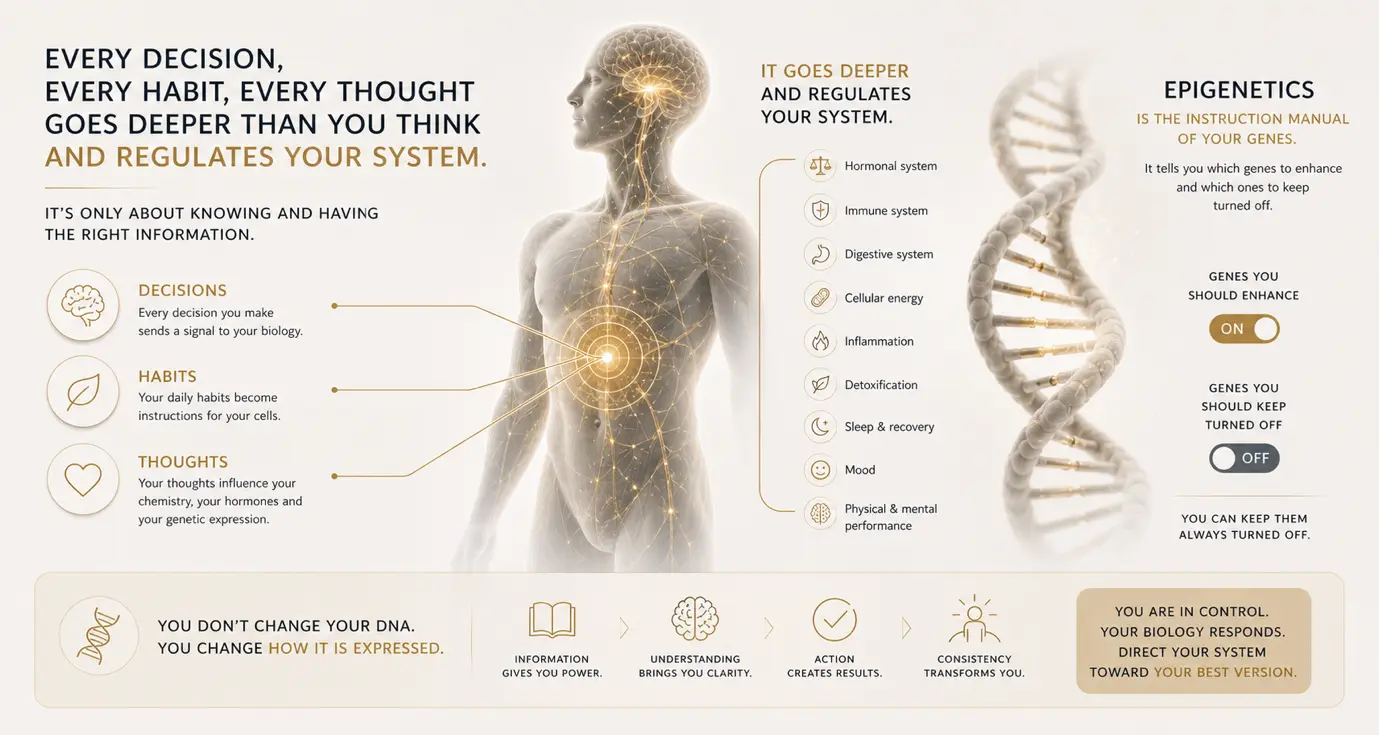
Your DNA stays the same. Its expression can change.
We are born with DNA that does not change. It contains all the genetic instructions of our body.
Epigenetics studies how internal and external factors—such as nutrition, sleep, stress, environment, and even thoughts—modulate gene expression, meaning they influence which genes are turned on and which are turned off.
It’s like having a complete instruction manual: the content stays the same, but which parts are used can vary.
However, there is something important: not all genes are active at the same time.
This happens through biological mechanisms that regulate how DNA is “read,” without altering its structure.
That’s why biology is not a fixed system, but rather dynamic and adaptive, constantly responding to the way we live.
“In other words: we cannot change our genes, but we can influence how they are expressed.”
The signals you don’t see
Your environment is talking to your cells.
You are not only influenced by what you do… but by what you are constantly exposed to — even when you are not aware of it.
Every day, your body is in silent communication with your environment.
Not just through food or lifestyle, but through invisible signals:
radiation, chemicals, air quality, light, and environmental stressors that your eyes cannot detect… but your cells constantly interpret.
Your body does not question these signals. It responds to them.
These exposures can either support your biology… or slowly disrupt it.
Affecting:
Cellular balance
Hormonal signaling
Inflammation
And ultimately, how your genes are expressed
This is what science defines as your exposome.A continuous flow of information that shapes your biology over time.
Which means:
your health is not only built by your habits, but also by the environment you live in — including the one you don’t see.
02
03
Before imbalance appears
When symptoms don’t explain the whole story.
Because true health is not about waiting for imbalance to appear, but about understanding your body before it loses its harmony.
You can feel that something is not right… even when everything looks “normal.”
Fatigue, inflammation, digestive discomfort, hormonal changes—and yet, your lab results fall within normal ranges.
But “normal” does not always mean optimal. Most imbalances begin quietly at a functional level long before they become a diagnosis.
Your body is already sending signals—they’re just often overlooked.
An epigenetic analysis helps you go deeper: to understand not just what is happening, but what is influencing your biology beneath the surface.
It can help uncover:
Hidden environmental stressors
Specific nutritional needs
Early inflammatory patterns
Subtle imbalances across key systems
Because real health is not about waiting for disease—it’s about understanding your body before it breaks down.
The essence of epigenetics
You are directing your biology.
Your body is not simply reacting to life. It is constantly adapting, learning, and responding to every signal you give it.
At every moment, your cells are interpreting your environment, your habits, your thoughts—translating them into biological responses that shape how your body functions.
This is the essence of epigenetics.
You are not just living your life... you are directing your biology!